
A few years ago, “hybrid event” was a term most Malaysian companies only encountered when something went wrong, like a keynote speaker who couldn’t travel or a last-minute venue capacity issue. Today, it’s a deliberate format that organisations are planning for from day one. If you’re still unclear on what it actually means, or trying to figure out whether it’s the right approach for your next event, this article breaks it down.
What a Hybrid Event Actually Is
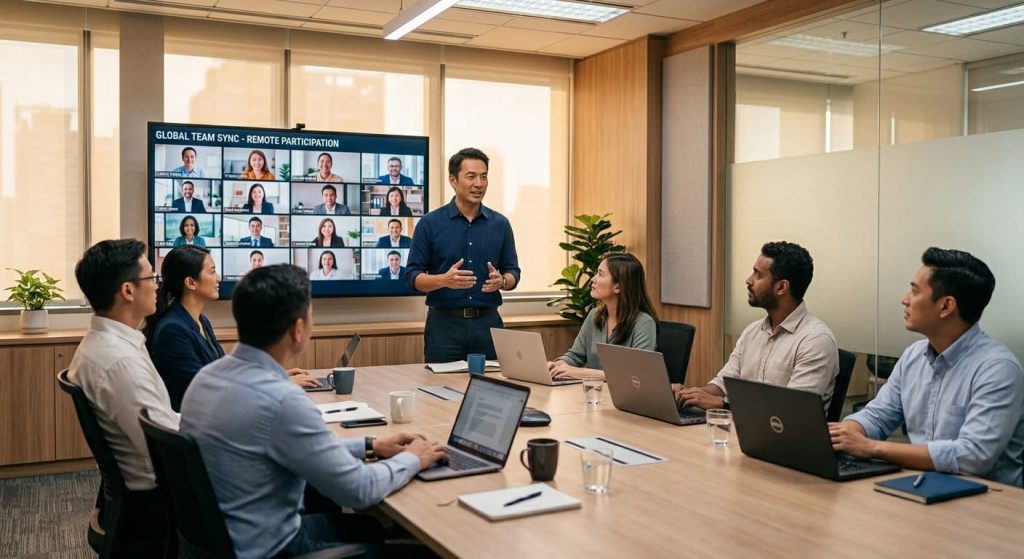
A hybrid event combines a live, in-person gathering with a simultaneous virtual component. Attendees can participate from the physical venue or join remotely online, and both groups experience the event at the same time. It’s one event, but it runs across two environments.
This is different from simply recording a session and uploading it afterward. In a proper hybrid event, virtual attendees can follow presentations in real-time, participate in Q&A, submit votes, and interact with the event as it happens. The degree of integration between the two audiences is what separates a well-executed hybrid event from a livestream with a chat box.
There are a few common formats. The most straightforward is the simultaneous hybrid, where in-person and virtual audiences attend live at the same time. A hub-and-spoke model uses one main venue as the broadcast hub while smaller groups gather at satellite locations and join virtually. There’s also the live studio format, where presenters perform to a smaller on-site audience while a much larger virtual crowd tunes in, similar to a broadcast production.
Why Malaysian Companies Are Moving Toward This Format
The shift has been building for a while, but a few specific factors have pushed hybrid events into the mainstream here.
The regulatory angle is worth noting. Since March 2025, Bursa Malaysia requires all public-listed companies to conduct AGMs at a physical venue rather than fully virtual. Before this ruling, more than 50% of Malaysian PLCs were still running fully virtual AGMs even after the pandemic ended, according to the Securities Commission Malaysia. The new requirement didn’t push companies back to purely in-person meetings. Instead, it accelerated the adoption of hybrid formats, where shareholders can attend physically or participate online with full access to voting and Q&A.
Beyond compliance, the business case is straightforward. A hybrid event removes the geographical constraint on who can attend. A company town hall held in a KL ballroom can now include employees in Penang, Johor, Sabah, and Sarawak without requiring everyone to travel. Product launches can reach media and trade partners across the region. Conferences can bring in international speakers without the cost and logistics of flying them in. The audience size becomes limited by interest, not by plane tickets or venue capacity.
There’s also a cost consideration. Keeping a portion of your audience virtual reduces catering, accommodation, and logistics costs for those participants. For recurring internal events, the savings across a full calendar year are material.
What Types of Events Work Well in Hybrid Format
Not every event translates well. Hybrid works best when the content is presentation-driven and the value is primarily in accessing that content, asking questions, and receiving information. The format is well-suited to conferences, AGMs, product launches, town halls, training sessions, award ceremonies, and annual general briefings.
It’s less effective for events where the primary value is physical interaction, such as networking dinners, hands-on workshops, or team building activities where participation requires being in the room. For those, the in-person experience is the product, and a virtual component tends to feel like an afterthought.
What Goes Into Producing a Hybrid Event
The production requirements are more demanding than a standard in-person event, and this is where many first attempts fall short. Running a hybrid event well requires more than pointing a laptop camera at the stage.
At minimum, you need professional cameras, reliable high-speed internet with a dedicated connection for streaming, quality microphones that capture speakers clearly, a streaming platform, and a production team that can manage both the physical venue and the virtual feed simultaneously. Virtual attendees should see a broadcast-quality picture and hear clearly. If the audio drops or the stream buffers, the remote audience disengages immediately.
Engagement for virtual attendees also needs deliberate planning. A live Q&A function, polling, and a moderator managing the online audience are not optional extras. Without them, remote participants are passive viewers, which defeats the purpose of running a hybrid event rather than simply recording it.
The physical venue itself has to accommodate the production setup. Camera positions, lighting rigs, streaming stations, and dedicated internet infrastructure all need space, and they need to be factored into the venue layout early, not squeezed in on the day.
How to Get It Right
A few things separate hybrid events that land from those that frustrate both audiences.
- Plan for both audiences from the start. If the virtual component is an afterthought, it shows. The programme flow, presenter briefings, Q&A timing, and technical run-throughs should treat the online and in-person audiences as equally important.
- Run a full technical rehearsal. Stream the test to all devices your audience might use, check audio levels at every mic position, and confirm the platform can handle your expected attendee numbers without degrading.
- Appoint a dedicated online host. Someone needs to monitor the virtual platform throughout the event, relay questions from remote attendees to the room, and ensure the digital experience stays active. The on-stage emcee has enough to manage on the physical side.
- Finally, record everything. One of the underused advantages of hybrid events is the content it generates. A well-produced recording of your conference or product launch has shelf life well beyond the event day.
Planning Your Next Hybrid Event in Malaysia with Events Wizard
Hybrid events are more complex to produce than purely in-person ones, and the gap between a well-executed hybrid and a poor one is visible to everyone in the room and online. Getting the production right, the staging right, and the logistics right across both environments simultaneously is where experience counts.
If you’re planning a hybrid event in Malaysia and need an event management partner who handles both the physical production and the technical side, Events Wizard has been delivering corporate events in Malaysia for over 20 years. We work with the AV, staging, and logistics under one roof, which makes hybrid event production considerably more straightforward. Reach out to us to discuss what your event needs.